
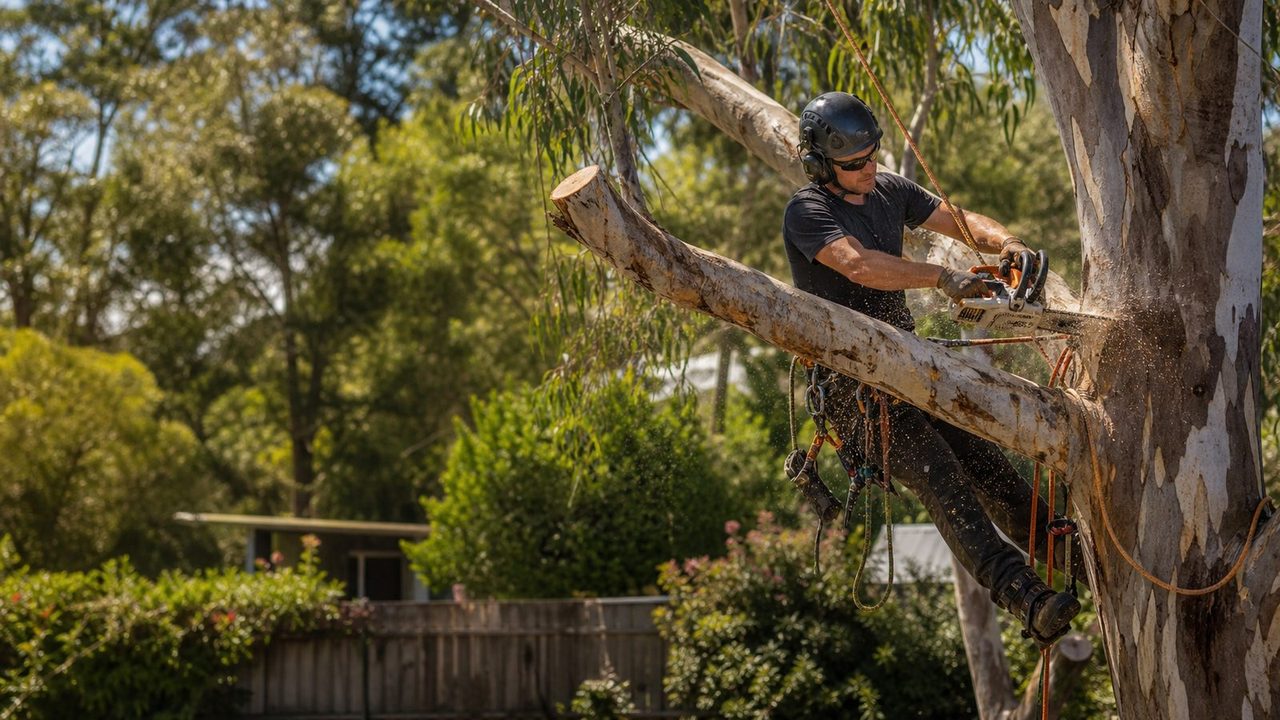
Follow the whole route from street to tree
A tree can stand in a spacious backyard while the only way to reach it is a narrow passage beside the house. The removal method depends on the entire journey, including where the vehicle can stand, how equipment reaches the tree and how timber returns to the loading point. Before comparing quotes, sketch that route from the street. Include gates, corners, steps, roof overhangs, garden beds and anything that cannot be moved. A photograph of the trunk alone leaves most of the access problem unanswered.
On a sloping Gosford property, the route may involve a driveway followed by stairs. A Terrigal backyard may have a pool between the tree and any clear working area. A peninsula property might have a straight side passage that narrows at a meter box. Describe the feature you actually have rather than calling the site easy or difficult. Those labels mean different things to different contractors. Your aim is to let each person assess the same physical constraints before they propose a method and price.
Measure openings without choosing the machine yourself
Measure the clear opening that equipment would actually pass through, not the nominal width of the gate panel. Note hinges, latches, downpipes and changes in level. Include headroom under eaves and any sharp turn immediately beyond the opening. Photographs from both directions help show whether a passage is straight or funnels into a smaller space. Take measurements only where you can do so safely from the ground. Do not climb structures, enter an unstable area or approach a suspect tree to obtain a more complete brief.
The contractor should decide which equipment can use that route safely. A machine that fits through the first gate may still be unable to turn, travel across the surface or work at the destination. Ask what access assumption the quotation uses and whether it has been checked at the property. If a fence panel must be temporarily removed, identify who owns it, who will agree to removal and who reinstates it. Put reinstatement in the scope instead of treating it as an informal favour expected at the end.
Understand the proposed method as a homeowner
Sectional dismantling means the tree is taken apart in pieces rather than felled as a whole. Depending on the assessment, a contractor may propose climbing, an elevated work platform, a crane or a combination. A small yard does not automatically require a crane, and visible street access does not automatically make one suitable. Ask the contractor to explain how the chosen method addresses the tree's condition, adjacent buildings, access and the place where material will be received. You need the reasoning, not instructions for operating the equipment.
SafeWork NSW's tree-work guidance covers hazards and planning for professional tree operations. Use it as a prompt to ask who controls the work area and how people are kept clear. Homeowner preparation should support the contractor's plan, not substitute for it. Do not offer to hold ropes, steady a ladder or drag branches out of an active work zone to reduce the quote. If an operator relies on household members joining the crew, clarify that arrangement before booking.
Name the objects that need protecting
List the roof, gutters, solar panels, pool fencing, glass balustrades, paving and garden features around the tree. Include items that are easy to miss from a street inspection, such as a skylight behind a roof ridge or a pump enclosure beside the access path. Tell the contractor which objects are movable and which are fixed. The practical difference matters: a pot can be relocated before work, but a retaining wall, gas meter or fixed pool barrier cannot simply be treated as clear ground.
Discuss protection in terms of the actual surface and movement expected. Ask where timber will be set down, where equipment will travel and how the agreed garden features will be protected. A general phrase such as all care taken does not tell you whether a delicate tiled path is included in the access plan. Take ordinary before-work photographs with the contractor's knowledge so that the starting condition is recorded. Keep this discussion separate from any guarantee: protection measures reduce exposure but do not make every possible outcome predictable.
Check where the vehicles and machinery can stand
The nearest parking space is not necessarily a usable loading or machine position. Describe a steep driveway, restricted street parking, shared access, a narrow verge or a surface covering underground infrastructure. The operator must assess ground and setup requirements. A homeowner should not declare that a driveway or buried tank can support a particular machine. If you have relevant drawings, provide them and ask what additional information is needed. Agree what happens if the anticipated setup position is unavailable when the crew arrives.
If work may affect the footpath, road or neighbouring access, ask who checks the applicable permissions and manages those arrangements. Do not assume that cones placed by the homeowner are sufficient. Keep the driveway available as agreed and tell the contractor about school traffic, a shared garage or a regular delivery that could interfere with the proposed setup. These are scheduling facts for the site plan. They are not reasons to improvise a new machine position on the morning of the job without reassessment.
Account for the timber journey out of the yard
Removing the standing tree and removing the resulting material are separate parts of the same job. Large pieces in the backyard still need a route to their final destination. Ask whether the quote assumes mechanical handling, hand carrying or retaining some material on the property. A constrained exit can make the handling stage a substantial part of the work even after the canopy is down. Describe stairs, long passages and internal courtyards when requesting the quote, not after agreeing a price based on open access.
Be clear about what remains. If you want timber retained, mark an agreed storage area that does not block the access route or later stump work. If you want everything removed, check that the wording includes both logs and chipped branches. Chipping does not mean the chips leave automatically. Our mulch and log handover guide helps separate those choices. A quote that removes the tree but leaves a pile you cannot move is a different service from one that leaves the area ready for the next contractor.
Treat the stump as another access problem
The access solution for the standing tree may not solve access for a stump grinder. A crew may reach the canopy without bringing a ground machine through the passage, while the stump operation needs a different route. Ask whether the stump is included, whether the proposed equipment can reach it and whether grinding will occur during the same attendance. If a return visit is expected, establish whether any temporary fence opening or cleared access must remain available until that work is completed.
Describe the intended use of the area after removal. A garden bed, lawn and proposed structure require different follow-up discussions. Avoid specifying a universal grinding depth from an online article. Provide the landscape or construction requirements and let the relevant contractors agree what needs to be removed, investigated or reinstated. Buried services and nearby retained roots may constrain the operation. Check the stump-grinding service scope and ask for any exclusions to be written beside the tree-removal scope so nothing disappears between bookings.
Plan access for people during the work
A side passage may be the household's normal route to bins, laundry or the back door. Tell the contractor if closing it leaves someone without a practical way in or out. Discuss pets, deliveries and anyone who needs predictable access, including a resident who cannot easily use another entrance. Agree a contact person and how the crew will tell you when an area can be used again. A closed work area should remain closed until the responsible person releases it, even if the cutting appears to have stopped.
Neighbours may also be affected by vehicle positions or noise. Give them practical information once the contractor has confirmed the arrangement, including which access is affected and whom to contact about a problem. Do not promise an exact completion time unless that has been agreed and remains realistic. Keep any neighbour permission for access separate from your tree-work authorisation. A friendly conversation across the fence can help coordination, but it should not become an assumed right to move equipment or timber across someone else's property.
Compare quotes by their access assumptions
Place competing quotations beside the same site sketch and photographs. Check whether each includes the same tree, waste outcome, stump option, temporary access changes and reinstatement. Ask what could change the price or method after inspection, and how that change would be authorised. One quote may appear lower because it assumes driveway access that another contractor has ruled out. Resolve the assumption instead of comparing the totals as though both describe identical work. Ask for clarification before accepting either version.
Before the work date, confirm that approvals and agreed access arrangements are in place, movable items have been cleared as requested, and everyone has the current scope. If conditions change, such as a vehicle blocking the setup area or the tree deteriorating, tell the contractor before arrival. At handover, walk the agreed accessible areas together and check the waste, stump and reinstatement items against the quote. The useful outcome is a completed job with a clear record of what was done and what remains for later landscaping or repairs.
Record your access constraints
Select what you already know, then add the unresolved question. This creates a note to keep or share with your enquiry, not an assessment or permission to carry out work. Nothing entered here is sent to us.
Questions answered
Does a narrow gate mean the tree cannot be removed?
Not necessarily. Ask for an on-site assessment of available methods and material handling. Do not widen or remove structures before an access plan is agreed.
Should I book a crane myself?
Ask the tree contractor to assess and coordinate any proposed crane requirement. Booking equipment before its suitability and setup are established can create avoidable cost and delays.
Can the crew use my neighbour’s driveway?
Only after the relevant permissions and practical arrangements are established. Tell the contractor it is an option to discuss, not confirmed access.
Have a tree behind a narrow passage?
Describe the entire access route and what surrounds the tree. Ask for a removal scope that explains handling, protection and the final waste outcome.
Discuss your tree work Tap to call